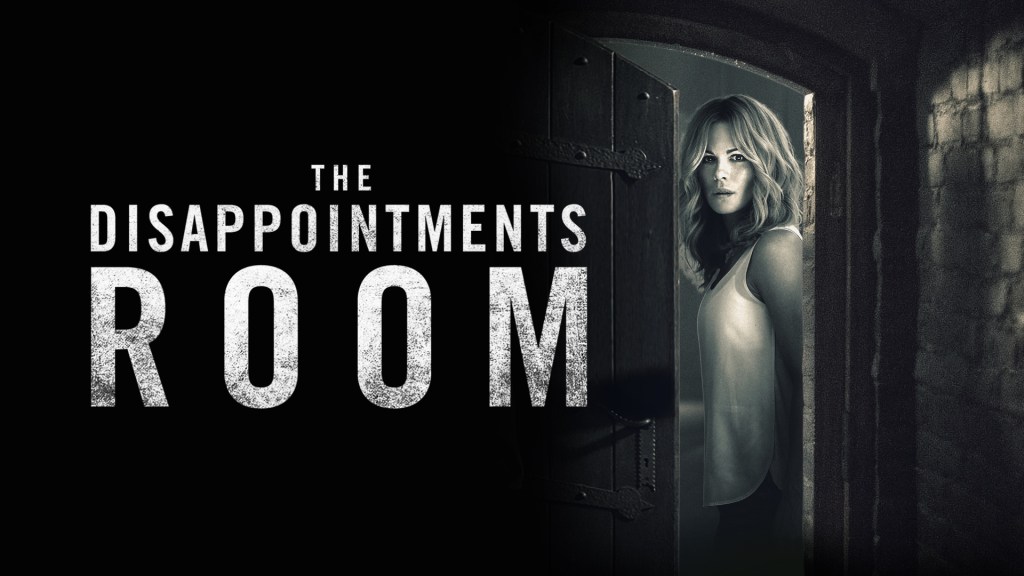
• The Disappointments Room Review

    I have just recently watched the movie The Disappointments Room for a research project on disability tropes I’m working on. I’ll give it two stars because watching the beautiful Kate Beckinsdale do anything is a treat.

    As far as disability representation goes, though, this movie is a dud. Disability acts more as set dressing. Don’t get me wrong, I loved seeing disability references and imagery sprinkled throughout the first half of the film: Lucas (the son) playing with his father in Wolverine and Hulk costumes and mentioning mutants out loud, yellow wallpaper, the statue in the garden missing limbs, a throwaway joke line about “zombie rednecks” (gotta love the rural inbreeding stereotype), etc. However, this is about as deep as it goes. 

    The plot of this movie is nearly incoherent. It’s unclear whether the unnamed girl born with a deformity and kept in the titular disappointment room is haunting the house with her grief, or her terrible father just maintaining a demonic presence is the reason for the haunting. The titular concept of a disappointment room is hardly explored at all, save for a visit to the county archives where a plucky paranormal investigator lady shares all her research on the house. All she shares, though, ends up being conveyed in short shots of book pages covering historic cases of disappointment rooms that don’t pertain to the actual family in this story (and that I doubt the average viewer paused to read). All we learn about the Blackers that originally owned the house is that the patriarch was a judge. 

    Unfortunately, this movie follows the pattern of many before it in which this horrifying history is just used as a vehicle to a haunted house. The haunted house is merely a catalyst for Kate’s character, Dana, to confront her own internal struggles. The real core story of the film follows her journey through grief, motherhood, and mental illness. It also doesn’t do that part particularly well, either. 

    Mental illness and madness are very relevant to disability studies, but this movie doesn’t explore them well. Essentially, Dana’s mental state is conveyed through hallucinations mixed with paranormal flashbacks that make it impossible to tell where reality begins and ends. Although this puts the viewer in Dana’s seat, confusing us, the paranormal element just seems to undermine the other hallucinations. When madness is compared and equated to a spooky haunting it is pretty reductive. 

    In a scene that baffles me, Dana’s husband David fakes a business trip in order to secretly go back to the city and talk to Dana’s (?) psychiatrist about what to do. This is bizarre to me for many reasons. Is this Dana’s doctor, or David’s? Why is this trip a secret? Why is the doctor’s advice just to have a dinner party? Why does the psychiatrist merely consult David, which seems to be a pretty unprofessional move? 

    Dana is also seen flushing pills that are never named. We get the age-old generic “have you been taking your meds?” back and forth we’ve seen a million times before. 

    I do think this storyline had potential that was squandered. It is very interesting to see a mother who has been devastated by the loss of her child confront the dark history of parents who purposefully off their own. Filicide is much more common with disabled children than people realize, and this is a horrifying reality. When it is (predictably) revealed that, albeit accidentally, Dana is the one who killed her daughter, this only enriches that potential dynamic, which remains underexplored. Instead, this just becomes a twist reveal that is ultimately little more than a footnote and doesn’t recontextualize the rest of the film very effectively. The movie would have been equally uncompelling regardless of whether Dana has blood on her hands. 

    The conclusion of the story is that the family will be moving back to the city to focus on Dana’s recovery. The story of what happened to the little girl kept in the disappointment room is not acknowledged again, beyond David removing the door from her room. That’s cool and all- to symbolically free her, but maybe clean up her grave site that you dug up, put her tombstone back, and maybe tell her story to the county archives lady so that this innocent little girl is not forgotten. I don’t know. Please just don’t leave her skeleton in the dirt like that. 

    But what the hell, Dana is an architect girlboss with a house husband, a subversive feminist win!

  • Ableism and mental health popped up in popular kpop discourse again this week. I, of course, took the opportunity.

  • Surprise Crossover Post!

    I have one other blog that I never linked here because I didn’t think the streams would cross much. It turns out I was wrong, though, because an ableism-related scandal occurred in the kpop scene! Here is my post about it!

  • Sammy, when I dream of our future, I dream we are happy. I don’t dream that you are some miracle genius with some illustrious career and fame. I don’t dream you’re a hidden savant. I don’t dream you’re Temple or Raymond. I don’t dream for you to suddenly prove your worth in the eyes of bigots by fitting in their box. I don’t dream of you becoming more easily exploitable. And most importantly, I would rather die than watch you and your autism disappear one day and watch a stranger move in behind your face. I don’t want you to lose a single piece of yourself. I don’t want to lose a single piece of you. 

    I don’t dream for you to “be able” to hold a job like that’s some determinant of human worth or quality of life. I dream we’ll live comfortably and you’ll never have to work a day in your life. But even still, I dream for you to be able to keep yourself safe if something happens to me one day. 

    When I dream of our future, I dream for you to be able to communicate with any person you want to. I dream for you to express yourself in a way that is comfortable and not draining for you. I dream for you to feel that you are being heard. I dream for you to know that your thoughts, ideas, and feelings are being valued. 

    When I dream of our future, I dream that I will succeed in teaching you how to read. I dream that your entire world pops open. I dream that you have access to all sorts of opportunities you don’t have now. I dream you can learn any new skill or hobby you want. I dream you can meet like-minded people. I dream you can read any story, and carry out any fantasy. 

    When I dream of our future, I dream of you being more comfortable in our world. I dream that as you grow older, we find more and more coping mechanisms that help you find your own place in our physical environment. I dream that you can stim freely without a second thought. I dream that we find ways to accommodate any sensory issues you have. I dream that you can take your place and own it. I dream that you have more control.

    I dream that I can spoil you and you can indulge in your special interests and collect all you want. 

    I dream that we have a house and a pool where you can go swimming at midnight like you always want to. 

    When I worry for our future, I pray we’ll have already equipped you with all the tools you need by the time we experience loss and grief. I want you to have a grasp of these key tools when we lose people. I want you to be able to talk to me when the time comes that we lose Eva or Olivia. I want you to be able to talk to me when we lose Mom and Dad. 

    You and I are probably going to be the last ones left. I want you to be able to talk to me. I want to be what you need. I want to always have each other. 

    I dream that you don’t get any taller than me than you already are now. You’ll always be my little sister, even if you’re a giant. 

    I dream your echolalia never fully goes away and that you use it to tease me for the rest of our lives. 

    I dream that your sense of humor never dies. 

    I dream that I can still hear your laugh every day. 

    I dream that I can still hear you squeal with glee no matter how old we grow. 

    I hope you’ll always find yourself too happy for words to contain it. I hope it bleeds over into every other language we speak together. 

    I dream that you’ll mock and make fun of me when we are old and wrinkly. 

    I dream that we still say “I love you more,” back-and-forth ad infinitum with gray hair. 

    I dream that these things never really go away. 

    I dream that the strong bellow of your voice never weakens. 

    I’ll never forget the sound of your footsteps. 

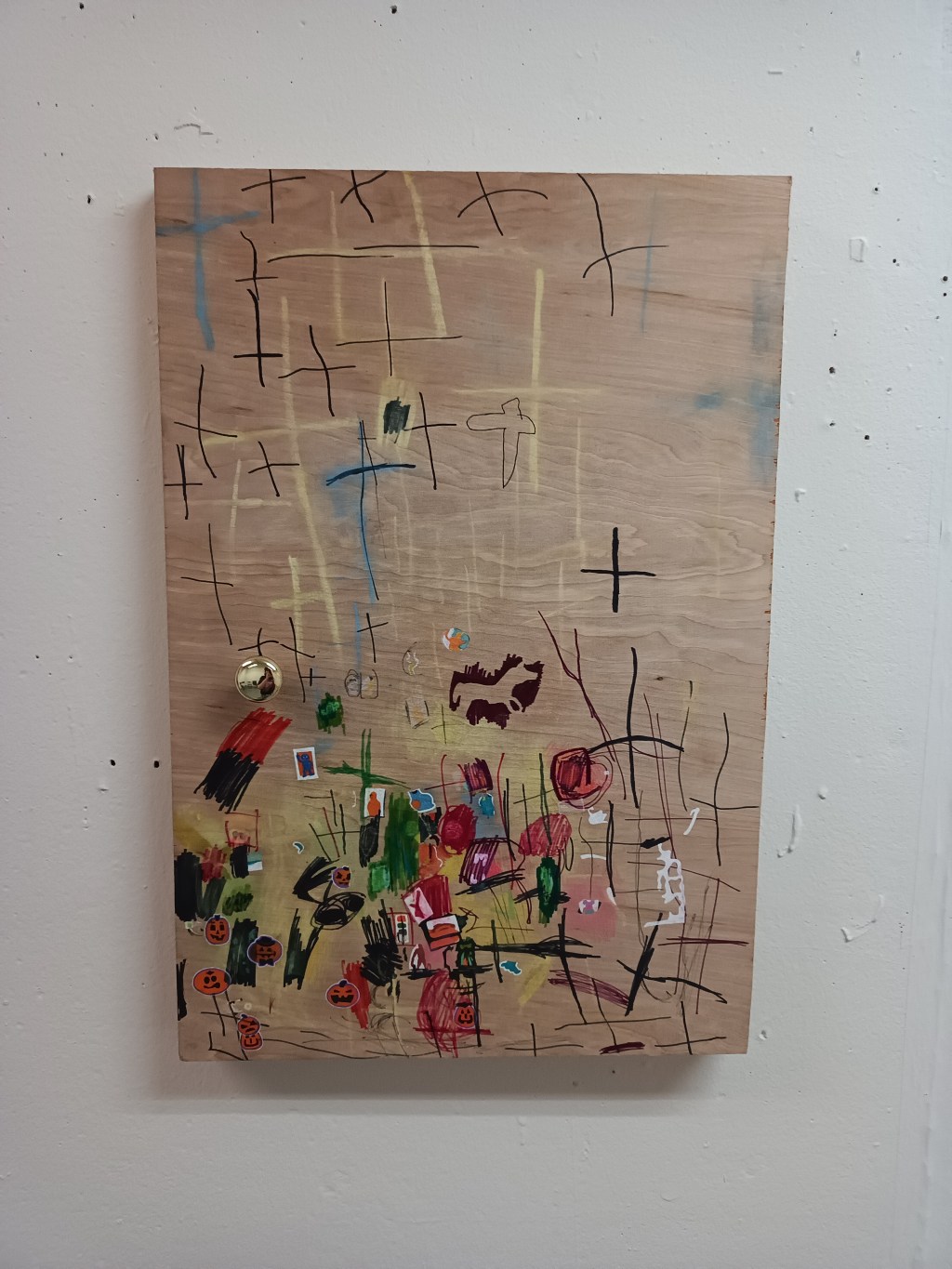
  • Basement Door

    In the house I grew up in, we had a spacious basement that housed our laundry room, my dad’s “man cave”, and a playroom for my sisters and I. Because Eva and Olivia could not go up and down the stairs easily, it was only Sammy and I who had constant access down there. 

    My dollhouse and toys that were choking hazards (which Eva and Olivia couldn’t be around) were down in the basement. I know I played down there by myself a lot. Dad says that Sammy played down there by herself a lot when I was outside with the neighborhood kids. I’m not sure how often Sammy used to hang out there by herself, but it was enough for her to deface one of the doors down there. 

    The logistics of this are a complete mystery. I have no idea how her tiny 7 year old self managed to reach the top of the door to draw on it. 

    I remember seeing the original door and my first impression being a little freaked out. My whole life I haven’t been very fond of the church, and this thing was covered in crosses. Half of them seemed to be inverse, too- like some trendy goth shit. 

    Back then, it crossed my mind that my sister might be channeling the holy spirit somehow, and the thought sent shivers down my spine. This was scarier to me than her being possessed by the devil. I’m not sure what my parents thought. 

    As an adult, now, I am learning as much as I can about the history of disability. It’s a scary thing knowing that if we were in a different time, this would be evidence of my sister being of the devil. It would be politicized immediately if anyone found out. An autistic little girl who speaks very little suddenly creating murals on the walls of her home consisting of religious imagery would be the type of thing voyeurous academics sunk their claws into. It would be a narrative spun and weaponized.  

    This basement is a very contentious space in my sister’s life that I’d like to ask her more about. I’m not sure how much she remembers from those years, or if she even remembers this door. If she’s anything like me, there are most likely a lot of pieces missing. But this basement is where a lot of my sister’s therapy sessions occurred in childhood. She had speech therapy, occupational therapy, tutoring, what have you, down there. And this basement is where my sister experienced her first session of ABA therapy. 

    I do have memories of sitting on the living room couch hearing her scream as she had a meltdown below me with the therapist. As a kid, I didn’t like it at all, but trusted my parents who told me it was for her own good. It didn’t take too long for us to quit ABA. 

    This piece is my warped memory of that door. 

    The process of me remaking this door helped me find a fresh appreciation for the similarities and differences between my sister and I’s art itself as well as our processes. My father made a mini version of the door for me, which is fitting, since I’m pretty sure he also made the original door himself. He’s a handy guy. 

    I feel that it’s important to acknowledge that by disclosing her diagnosis, her artwork and behavior will inevitably be pathologized. But this is a reality I must live with. We don’t exist in a vacuum. In truth, though, art is an impulse that we all share, and is something precious and to be respected. Not exploited.

  • “@DeafOn4Wheels: Unpopular opinion maybe, but I don’t think ‘stupid’ and ‘dumb’ are ableist ‘slurs’ unless they are literally directed at a person, in that way. We have so many real issues.  Why look for more things to be offended by?”

    It’s less about those terms being slurs and more about our culture as a whole. We live in a society where the actual first core belief is that humans are the most intelligent species and therefore rule the world. Intellectual supremacy is so fundamental we don’t even notice.

    To imply that the use of words like stupid is a frivolous issue and not worth the energy when we have “real” issues is condescending at best. We live in a world where the justification for equal rights has always been argued as “we are just as intelligent and capable of labor.”

    BIPOC, women, and the LGBTQ community all assert their humanity, their right to participate in our world, because they are just as intelligent. And on the flipside, white supremacists and misogynists argue that a disparity in IQ is justification to subjugate. This phenomenon is not a reflection on those oppressed, so much as a reflection of what rhetoric and talking points actually have worked to embolden the masses and invoke change. Productivity- linked to intelligence- is also a huge incentive to grant human rights in a capitalist nation. 

    We live in a world where these issues are very real. We live in a world that is segregated. Where the mentally “unworthy” are institutionalized. 

    The narrative of education and intellectualism justified colonialism. There are still debates about who should be able to vote or run for office based on intelligence. There are people out there who believe that intellectually disabled lives are disposable.

    There is the narrative that nerds rule the world. That jocks and hot girls won’t be the ones with the last laugh. It’s in our pop culture.

    I think about Trump and the people who would say that his supporters are dumb and the world would be better off without them. People who consider themselves the pinnacle of ethics.

    There’s people who crusade for animal rights, because animals don’t know any better and don’t have the capacity to be as intelligent as us. Meanwhile the subjugation of intellectually disabled people is fine because they didn’t reach full capacity and didn’t make the cut.

    People who are mentally disabled get paid less for the same labor simply because they are disabled. The developmentally disabled population is larger than the deaf and blind populations combined and yet you hear a lot more about the latter two.

    When intellectualism is baked so deep that philosophers ponder what defines humanity as a species and it is intelligence, when that’s our existence’s bottom line, where most of our beliefs are predicated on the idea that knowledge is power… A stupid person is less than human.

    The irony in my having to study and read so much in order to properly advocate for the humanity of my developmentally disabled sisters is not lost on me.

    I think about how people say they don’t hate mentally disabled people because it’s not their fault they’re unintelligent. That implies that neurotypical people that happen to be less intelligent are that way of their own fault.

    Is it a person’s responsibility to study as a method of self betterment? Is it considered a public decency much like personal hygiene? Is it a moral failing to not be smart?

    People say shit like we are better off without hicks and rednecks and cold shit like that. Is a person’s worth inherently less because they have been sheltered and indoctrinated into a narrow way of thinking?

    If you’re a dumb-ass, is it your fault? Is it a vice to inconvenience others by not thinking in the same way they do? Does the responsibility lie with an individual to make themselves smart enough to be “tolerable” or “useful”?

    Is it the responsibility of the government to provide education? Then is it considered a failure when public schooling does not leave someone at a satisfactory enough mental level to meet societal expectation? Is it the fault of our poor education system?

    This is all also said with the assumption that intelligence is quantifiable in one way and exists in one form. What about different forms of intelligence? Is interpersonal intelligence and logical intelligence more important than other forms?

    Really question everything you believe and take for granted. How many times have you told someone off for being stupid?